cnshopper Volumetric Shipping Cost Guide
cnshopper Volumetric Shipping Cost Guide
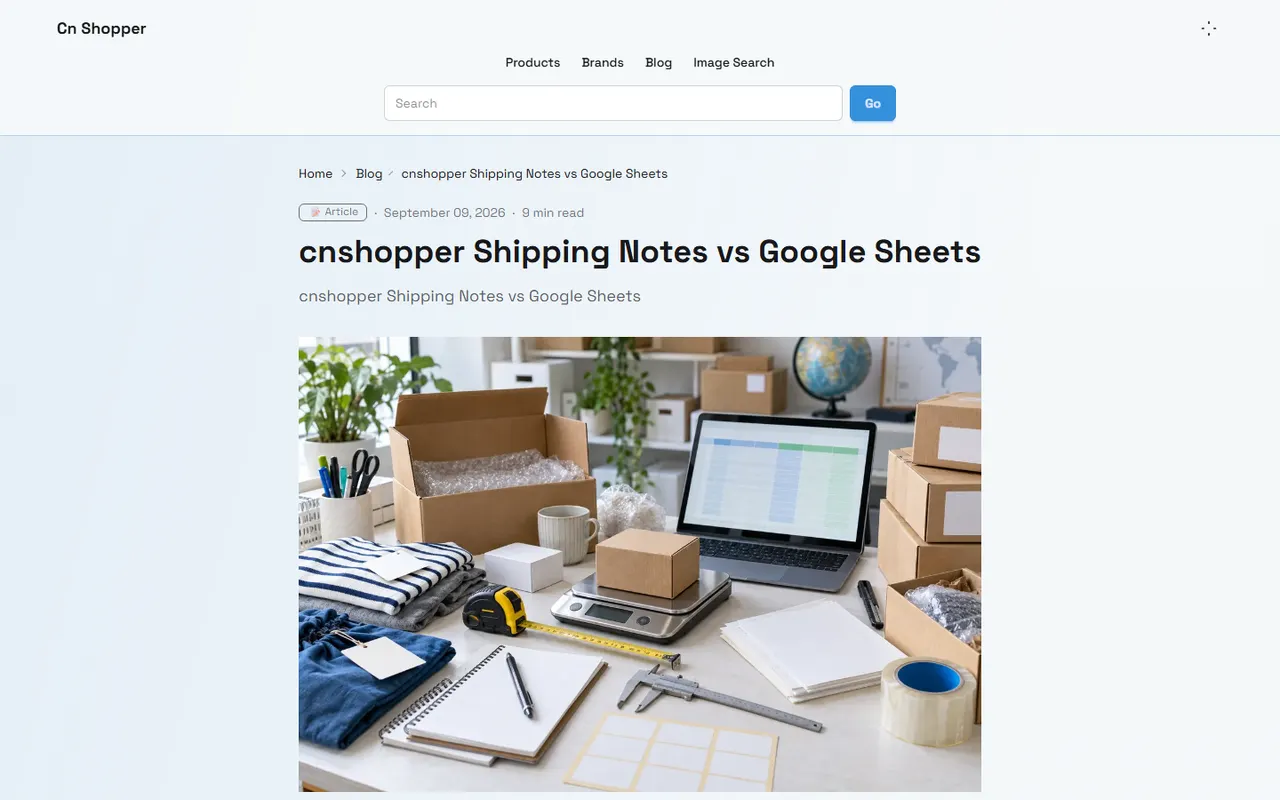
Caption: Use dimensions, weight, and packaging methods to estimate international shipping costs for lightweight bulky items on cnshopper.
Lightweight bulky items are the easiest way to blow your purchasing agent budget: the item itself may not be expensive or heavy, but once the outer box is large, the international shipping leg may be charged by volumetric weight. For cnshopper users, before placing an order, you can't just look at the item price; you must also consider visible dimensions, packaging space, volume changes after consolidation, and QC information after warehousing.
This article is suitable for users who are deciding whether to order lightweight bulky items like foam slippers, plush toys, hats, storage boxes, lamps, shoe boxes, gift boxes, and down-filled clothing. After reading, you should be able to build your own shipping cost estimation table and decide whether to buy directly, switch to an item with smaller packaging, wait for warehousing and then consolidate, or hold off on ordering.
This article is not suitable for confirming real-time route prices, specific item stock, a seller's current shipping promises, or destination country customs duties and taxes. Such information changes quickly; before ordering, always rely on the cnshopper page, warehouse measured data, route quotes, and destination country policies. The verification date of this article is 2026-09-14, and all calculation methods are for estimation and do not represent the platform's final charges.
First Determine If the Item Is Shipping-Cost Sensitive Due to Lightweight Bulky Nature
The core issue with lightweight bulky items is not "heavy or not," but "does it take up space?" If an item is very light but large in dimensions, the logistics provider may not charge international shipping by actual weight, but by volumetric weight or chargeable weight.
You can first screen with three questions:
Does the item have an obvious fixed shape, such as a shoe box, helmet box, model box, lamp box, storage box, or gift box?
Is the item not easily compressible, such as a hard-shell bag, sneakers, plastic box, or foam-packaged toy?
Does the item page show large packaging, a standalone gift box, a protective case, or multiple layers of protection?
If the answer to two or more is "yes," it is a shipping-cost sensitive item. At this point, don't just compare the item unit price; first estimate the chargeable weight after warehousing. 📦
Common lightweight bulky risks can be understood as follows:
Shoes: The shoe body is not particularly heavy, but the shoe box may increase volume.
Plush toys: Light weight, but compression limits, shape protection, and outer bag size affect billing.
Hats: One hat is not heavy, but hard-top hats or boxed hats are not suitable for flattening.
Lamps: Many foam protective layers, and the outer box is usually larger than the item itself.
Storage items: Low price, but size may directly push up international shipping costs.
If the item is low-priced, bulky, and non-compressible, the situation of "cheap item, expensive shipping" is most likely to occur.
Record Visible Dimension Clues in cnshopper Item Information
The information you can see before ordering is often incomplete, but still worth recording. You don't need to be very precise at first; just organize the clues that affect volumetric weight.
It is recommended to record these fields:
Item name and specification options
Visible dimensions, sizes, capacity, or packaging descriptions on the page
Single item weight or seller-labeled weight, if shown
Whether the item images show boxes, gift boxes, hard shells, or protective foam
Whether it is compressible, packaging removable, shoe box removable, or consolidatable
Purchase quantity
Destination country and planned logistics route
If the page does not provide clear dimensions, do not forcefully substitute with similar items. Mark it as "pending warehousing confirmation" and leave room for error in your budget. For lightweight bulky items, missing dimensions are more dangerous than missing weight, because if charged by volumetric weight, dimensional errors are magnified.
A practical approach is to categorize items into three types:
Low risk: Soft, compressible, no hard box, such as regular T-shirts, thin socks.
Medium risk: Has packaging but adjustable, such as regular shoe boxes, soft-packaged plush toys.
High risk: Hard box, large box, non-compressible or needs protection, such as lamps, models, storage boxes.
This way, before ordering on cnshopper, you will know which items must wait for warehouse actual photos and weighing before making a final judgment.
Distinguish Actual Weight, Volumetric Weight, and Final Chargeable Weight
When estimating shipping costs for lightweight bulky items, the most important thing is to distinguish three concepts.
Actual weight is the weight of the package on the scale, for example, 1.2 kg. Volumetric weight is a weight converted from length, width, and height to reflect the space the package occupies in transportation. The final chargeable weight is usually the higher of actual weight and volumetric weight, depending on the route rules.
A common idea for volumetric weight is:
Volumetric weight = Length × Width × Height ÷ Volumetric coefficient
Different routes, logistics providers, and destination countries may use different volumetric coefficients, and may have rounding rules, first weight/additional weight, minimum chargeable weight, or surcharges. Therefore, this article does not fix the real-time coefficient of any specific route. Before selecting a route on cnshopper, you should refer to the route description and actual quote shown on the page.
The table below can help you judge risk, not replace the final quote:
Item Situation | Shipping Judgment Focus | Actions Before Ordering |
|---|---|---|
Heavy actual weight, small volume | Mostly focus on weight and route unit price | Compare weight brackets of different routes |
Light actual weight, large volume | Focus on volumetric weight | Record length, width, height; prepare to wait for warehousing recheck |
Has hard box or gift box | Outer box may significantly enlarge | Ask if box removal or packaging reduction is possible |
Multiple items stackable | Consolidation may reduce duplicate packaging | Compare volume before and after consolidation after warehousing |
Fragile or irregular shape | Protective packaging cannot be casually reduced | Do not sacrifice protection to save shipping |
The key is not memorizing formulas, but knowing when formulas change purchase decisions. For example, an item with a labeled weight of only 0.8 kg but a large box may end up with a chargeable weight of several kilograms. Conversely, a batch of small items, although the total weight increases, if they can be tightly consolidated, the shipping cost per unit may decrease.
Use Packaging Methods to Estimate Cost Changes Before and After Consolidation
Consolidation is not always cheaper, and splitting is not always wasteful. When judging lightweight bulky items, consider duplicate first weight, outer box size, route restrictions, and single-shipment loss risk simultaneously.
Benefits of consolidation:
Reduces duplicate first weight or handling costs of multiple packages.
Multiple small items can share one outer box.
Easier unified tracking and unified receiving.
Risks of consolidation:
Outer box becomes larger, volumetric weight increases.
Package declared value concentrates, customs and loss risks concentrate.
Certain item combinations may not be suitable for the same route.
Fragile, irregular, and hard-box items may require more filler.
Splitting may be more suitable in these situations:
A single item's outer box is already large; further consolidation only enlarges volume.
Items have different attributes, suitable for different routes.
Destination country has obvious restrictions on package value, category, or size.
User wants to reduce single-shipment loss risk.
Therefore, after arrival, don't just ask "Can we consolidate?" but compare the chargeable weight before and after consolidation. At least look at four numbers: single item actual weight, single item outer box dimensions, estimated dimensions after consolidation, and route chargeable weight.
For example, if three lightweight bulky items shipped separately each have duplicate first weight, consolidation may save money; but if the outer box dimensions increase significantly after consolidation and the volumetric weight increase exceeds the saved first weight, it may end up more expensive. 🧮
Build a Lightweight Bulky Item Shipping Cost Estimation Table
The most reliable approach is to build your own estimation table. This table doesn't need to be complex, but it must separate "pre-order estimation" and "post-warehousing actual measurement."
Field | Pre-order Record | Post-warehousing Recheck |
|---|---|---|
Item name | Page title or specification name | Compare with QC information |
Quantity | Planned purchase quantity | Actual warehouse arrival quantity |
Visible dimensions | Page or image clues | Warehouse measured dimensions |
Visible weight | Page label if available | Warehouse actual weight |
Packaging status | Boxed, bagged, gift box, etc. | Whether box removal or packaging reduction is possible |
Estimated chargeable weight | Rough calculation from visible dimensions | Recalculate according to route rules |
Decision | Buy, switch, wait for confirmation | Consolidate, split, or cancel subsequent purchases |
When using this table, you can make decisions in three ranges:
Estimated shipping acceptable: Item price plus shipping is still below your budget, you can order.
Estimated shipping near upper limit: Buy a small quantity first, or wait for warehouse data before adding more.
Estimated shipping uncertain and item low-priced with large volume: Prioritize finding smaller packaging, compressible, or local alternatives.
The value of this table is not in getting it right once, but in avoiding repeating the same mistakes. Each time a cnshopper package is warehoused, fill in the actual measured data, and next time judging similar items will be faster. 📊
Which Dimensions and Weights Must Be Confirmed After Warehousing
Some information cannot be reliably confirmed before ordering and must be rechecked after the item arrives at the cnshopper warehouse. Especially for lightweight bulky items, the item dimensions shown on the seller's page are not necessarily equal to the logistics packaging dimensions.
Contents that must be confirmed after warehousing include:
Warehouse actual weight
Warehouse measured length, width, height
Whether there is an additional outer box, shoe box, gift box, or foam protection
Whether the item and packaging match in QC photos
Whether non-essential packaging can be removed
Whether the outer box after consolidation will exceed route size limits
Special note: Removing packaging is not always better. Shoe boxes, gift boxes, or protective materials may increase volume, but they also serve protection, identification, and resale value. For fragile, easily deformed, or gift items, do not blindly remove boxes to reduce volumetric weight.
If QC photos only show the item itself and do not clearly display the outer packaging, mark the packaging status as "unconfirmed." Do not guess box dimensions based on photo angles, and do not treat seller promotional images as warehouse measured images.
Before Ordering, Decide to Buy, Replace, or Hold Off
The goal before ordering is not to calculate shipping to the last cent, but to make an executable decision. It is recommended to classify lightweight bulky items into three handling methods.
First, continue purchasing.
Suitable for items with high value, irreplaceable, acceptable dimensional risk, or even if charged by volumetric weight still within budget. For example, if a specific style is only available from one seller and you are willing to pay for packaging volume, you can proceed.
Second, replace the item.
Suitable for items that are not scarce, have many similar options, and have obviously oversized packaging. You can prioritize finding soft-packaged, no gift box, small size, foldable, or compressible versions. For low-priced bulky items, switching to a link with more reasonable packaging is often more effective than later agonizing over consolidation.
Third, hold off ordering.
Suitable for situations where the page lacks dimensions, item images show a large box, destination route is uncertain, or budget is very shipping-sensitive. Holding off is not giving up; it's waiting until you find more dimensional evidence, alternative items, or recent route quotes before deciding.
When making the final judgment, use one sentence as a check: If the final shipping cost is 30% to 50% higher than estimated, am I still willing to buy this item?
If the answer is no, don't pin your hopes on "it might be small after warehousing." Lightweight bulky items are most afraid of wishful ordering, because once you regret after warehouse actual measurement, time costs, return costs, or domestic shipping costs have often already been incurred.
After Arrival, Recheck Estimation Errors and Update Records
After the item arrives at the warehouse, compare cnshopper's QC information, actual weight, dimensions, and optional packaging services with your pre-order estimates. This step directly improves the accuracy of your next judgment. ✅
When rechecking, it is recommended to do in order:
Check whether the item matches the purchased specifications.
Record warehouse actual weight and dimensions.
Judge whether the risk of volumetric weight billing is higher.
Compare the different consequences of box removal, packaging reduction, consolidation, and splitting.
Write down the reasons for errors in the estimation table.
Errors usually come from these places:
Seller did not show outer packaging dimensions.
Item image looks small, but protective foam is thick.
Multiple items cannot be tightly stacked.
Outer box enlarged after consolidation to protect items.
Route volumetric coefficient, rounding method, or restrictions differ from expectations.
The actual decision at the end of the article can be implemented as follows: If consolidation reduces duplicate first weight and volumetric weight does not increase significantly, consolidation is more suitable for multiple small items; if consolidation causes a large increase in outer box volume, concentrated declared value, or exceeds route limits, splitting is more prudent; if the item unit price is low but volumetric weight is too high, replacing or holding off is often more rational than forcing a shipment.
Money saved comes from reducing duplicate first weight, reducing excess packaging, and choosing a more suitable route; increased risks come from volumetric weight misjudgment, insufficient protection, concentrated customs value, and larger single-package loss. People suitable for this method are those who frequently purchase multiple items through cnshopper, are willing to record dimensions and compare options. People not recommended to use this method are those who buy only one low-priced bulky item, cannot accept shipping fluctuations, or need absolutely precise real-time quotes.
Treat lightweight bulky items as "item price plus space cost" and you will have fewer surprises. Estimate first, then recheck after warehousing, and finally choose consolidation or splitting based on actual measurements. This is more reliable than simply pursuing the lowest item price. 🚚
Agent Platform Shopping FAQ
1. What are QC photos?
Every dropshipping platform has a dedicated quality control team. When your items arrive at the cn-shopper.com warehouse, the platform performs quality checks and takes QC photos of your items. Usually three photos are taken, and the team checks whether the color, size, specifications, and quantity of the items match your order, and also checks for quality issues. However, electronic products are excluded; only their appearance is checked. If quality issues or incorrect size or color are found, the team immediately requests a return from the seller. This ensures you receive good quality products.
2. Why not use Google Sheets?
Google Sheets is only suitable for spreadsheets with a small number of products. Once the number of products increases, loading becomes very slow, and the system lags severely. Especially on mobile devices, the visual experience is poor and searching for products is extremely inconvenient. For the same set of products, the spreadsheet on the cn-shopper.com website loads faster and looks better.
3. How to evaluate product quality on cn-shopper.com?
To evaluate product quality, check the QC photos - don't rely only on factory photos, as those are often retouched. Use QC photos to confirm whether the product meets your specific requirements in detail, and then decide whether to actually purchase.
Also remember, you should avoid buying extremely cheap items because they are usually not of good quality.
4. What types of products can be found in the cn-shopper.com spreadsheet?
The cn-shopper.com website spreadsheet covers shoes, clothing, bags, accessories, jerseys, perfumes, hats, scarves, belts, and various household items.
Browse our latest products and find your next favorite item.