cnshopper Flight Footrest Buying Guide
cnshopper Flight Footrest Buying Guide
cnshopper Flight Footrest Buying Guide
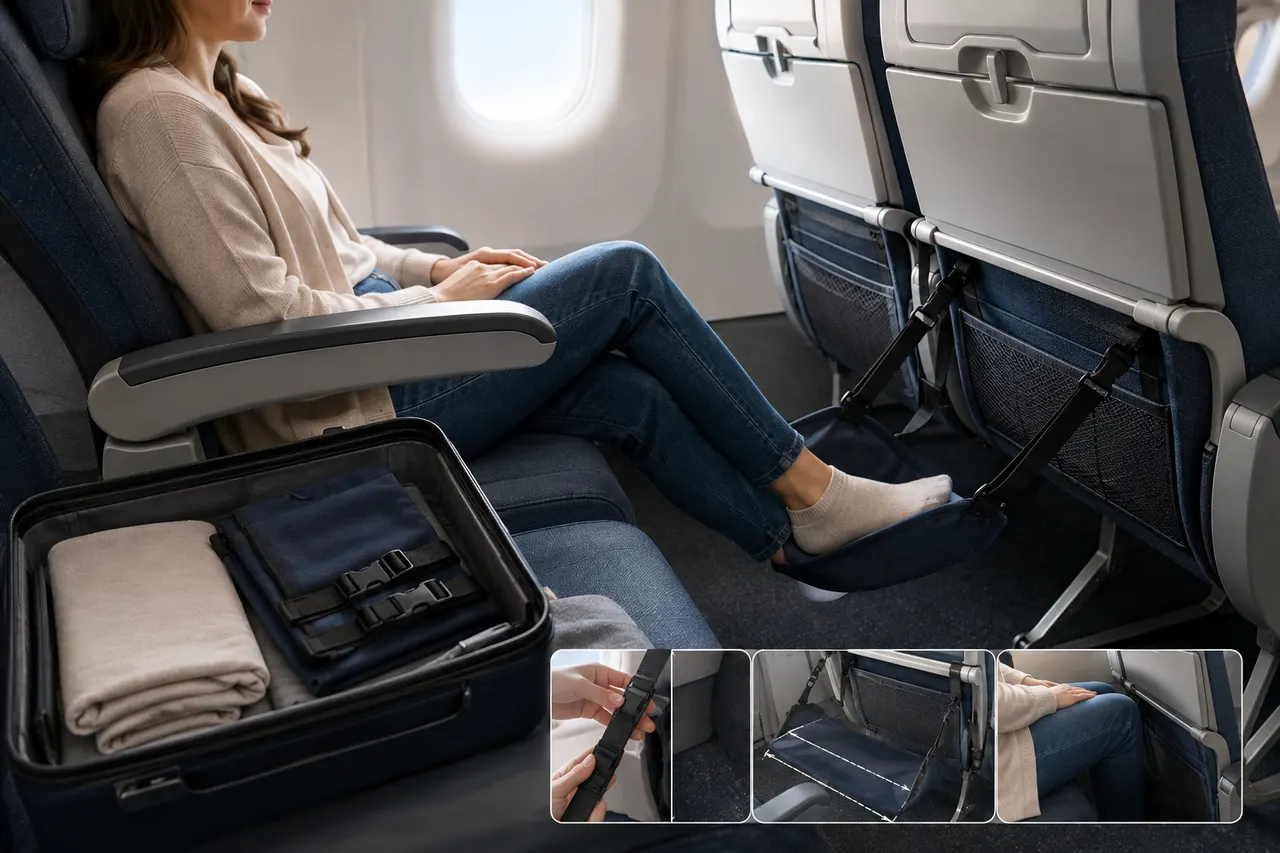
The purpose of a flight footrest hammock is to provide an adjustable support position for your feet when seat conditions allow. It cannot guarantee the elimination of leg numbness, swelling, or lower back discomfort, nor can it replace regular movement and necessary medical advice. The real question to solve is not "which one is the most comfortable," but whether a particular hammock can fit your leg length, sitting posture, the structure of the seat in front, and your carry-on luggage arrangement.
This article helps travelers preparing to find such items on cn-shopper.com organize screening criteria, verify page information, and create a pre-order checklist. It does not apply to travelers who must follow medical restrictions, nor can it replace airline cabin safety regulations.
Fact-check date: September 3, 2026. The current writing materials do not provide valid product samples, real-time prices, inventory, seller information, shipping, return/exchange policies, or specific purchase processes from cn-shopper.com that can be independently accessed and verified. Therefore, this article does not present these highly volatile pieces of information as established facts. When ordering, you should refer to the actual product page, checkout page, platform rules, and the latest requirements of the operating airline.
Clarify flight duration, height, and seating issues to relieve
Record your actual needs before searching for products. Just writing "long-haul flight" is not enough; consider adding the following information:
Expected maximum continuous sitting time and whether there are layovers
Height, approximate distance from knee to sole, and typical sitting posture
Whether you want to elevate the soles, support the heels, or allow the left and right feet to move independently
Whether you are prone to the hammock pressing on the top of the feet, feet squeezing together, or knees being raised too high
Whether you are willing to adjust the length repeatedly during the flight
Height alone cannot determine size. Travelers of the same height may have different leg lengths, and seat cushion height, distance to the seat in front, and equipment under the seat will also change actual posture. A more practical method is to sit at home at a height close to the aircraft seat height, measure the natural distance from the soles of your feet to the floor, and record the heights needed for "soles lightly touching support" and "heels being cradled."
If the goal is to relieve persistent discomfort, a footrest hammock can only serve as a posture adjustment tool. If you experience significant swelling on one side, pain, difficulty breathing, or other abnormal symptoms, seek professional medical help promptly rather than relying on travel accessories. 🩺
Check seat structure and available hanging positions first
Most such hammocks need to be hung from the structure in front, but whether they can be used depends on the actual seat. Before purchasing, check the aircraft type and seat information provided by the airline, and accept the reality that conditions may change after aircraft changes or seat reassignment.
Key points to verify:
Is the area in front a regular seat, bulkhead, emergency exit row, or other special layout?
Is there a hanging position in front of the seat that can be used safely without disturbing others?
Is there an in-flight entertainment box, power equipment, or carry-on items occupying space under the seat?
Could the hammock touch neighboring seats, block the aisle, or affect the front passenger's ability to recline?
Do the airline or crew restrict use during taxi, takeoff, landing, or other phases?
Do not assume that the tray table is suitable for bearing the tension generated by the hammock. Product promotional images only illustrate intended use; they do not prove that the tray table, hinges, or locks on a particular aircraft can safely bear the load. If after installation there is obvious deformation, looseness, unusual noise, or interference with equipment closure, stop using it immediately. ✈️
When viewing candidate products on cn-shopper.com, look for clear images showing the installation position, strap routing, and buckle connection method. Pages with only isolated white-background images, no installation illustrations, or no size information are insufficient to judge seat compatibility.
Choose size and adjustment range based on leg length and activity space
Size judgment should be based on three data points: total adjustment range of the strap, effective length of the footrest, and footrest width. A page that only says "adjustable" does not mean it covers your sitting posture.
You can pre-screen using the following method:
Record the approximate height from the floor you want the footrest to be at in your sitting posture.
Estimate the vertical distance from the hanging point to the footrest, rather than just looking at the total unfolded strap length.
Leave adjustment margin for the seat in front reclining and for changing your sitting posture.
Check whether the adjustment buckle is near the leg area or near the hanging point to determine if you can operate it while seated.
Check whether the footrest is large enough to accommodate the shoes you plan to wear, not just barefoot width.
If the hammock is adjusted too short, it may raise your knees too high and compress the back of your thighs; if adjusted too long, the footrest may touch the floor, lose support, or occupy space under the seat. A suitable state is typically one where the feet receive light support while the knees, hips, and ankles can still change angles.
Do not infer size from model photos. Camera angles, seat proportions, and model leg length can cause misjudgment. If the product page lacks specifications in centimeters or inches, mark the size as "to be confirmed" rather than treating slogans like "fits most people" as measurement results.
Compare trade-offs among single footrest, dual footrest, and divided structures
A single-piece footrest typically allows both feet to share one support surface, with a simple structure and easy storage, but the feet may slide toward the center. Independent dual footrests allow the left and right feet to adjust posture separately, offering more freedom of movement but also more parts and straps. A structure with a central divider is in between, reducing foot squeezing, but if the divider is not positioned properly, it may cause local friction.
You can judge based on the following priorities when choosing:
Want minimal storage volume: prioritize comparing lightweight single-piece structures
Feet easily squeeze together: look at divided structures or independent footrests
Frequently alternate stretching legs: focus on whether left and right feet can move independently
Wear bulky shoes: check footrest width, depth, and edge height
Sensitive to pressure on the top of the foot: check whether the force is concentrated on narrow straps or hard edges
Regardless of structure, none should be described as universally more comfortable. In narrow seat spaces, a wider dual-foot structure may actually restrict movement; with enough space, independent support may make it easier to change posture. 🦶
Check visible information on straps, buckles, and load-bearing parts
When you cannot touch the actual product, you can only make a preliminary judgment based on visible evidence on the page. Zoom in on product images and observe strap stitching, stitching areas, adjustment buckles, connection rings, and footrest edges.
Recommended item-by-item records:
Is the strap width clearly specified?
Are continuous stitching or reinforcement structures visible at the main load-bearing points?
Is there a clear close-up of the adjustment buckle, and is the closure method identifiable?
Are there any narrow, twisted, or sharp edges at the connection points between the footrest and straps?
Could the parts that contact the seat leave friction marks?
Is the material specified on the page specific to straps, buckles, and footrest, rather than vaguely saying "high-quality materials"?
Images can show structure but cannot prove material strength, long-term durability, or actual load-bearing capacity. Without test reports, manufacturer specifications, or other traceable evidence, do not calculate load capacity yourself, nor claim safety levels based on buckle appearance.
After receiving warehouse inspection photos, if the platform actually provides such services, you can specifically request or check full front and back views, close-ups of stitching, buckle closure status, fully extended adjustment strap, and size references. Inspection photos can only confirm visible appearance and cannot replace load-bearing tests.
Evaluate storage volume, cleaning method, and carry-on luggage restrictions
Long-distance travel accessories require a balance between "potentially improving sitting posture" and "extra carrying burden." Product net weight, folded dimensions, and whether a storage bag is included should all be confirmed before ordering.
If the page does not provide folded dimensions, you can request the seller or platform to provide photos of the folded state with a ruler. Judging the thickness after rolling based only on flat dimensions is inaccurate, especially for styles with foam, hard boards, or multiple buckles.
For cleaning, look for clear washing labels or manufacturer instructions. Do not assume it is machine washable, dryer safe, or can be disinfected with high heat before confirming the material. During travel, prepare a separate storage bag to prevent a used footrest from coming into direct contact with clothing and electronic devices. 🧳
Carry-on luggage restrictions are determined by the airline, cabin class, route, and airport enforcement, and may change. Before purchasing, check the latest regulations of the operating airline and account for the footrest hammock together with other carry-on items in terms of space and weight; do not rely solely on general descriptions on the product page such as "portable" or "cabin-friendly."
Record missing specifications and unverifiable load-bearing information before ordering
After identifying candidate products on cn-shopper.com, it is recommended to create a brief verification record for each link, including at least:
Product name and page access date
Dimensions, materials, colors, and available structures shown on the seller's page
Adjustment range displayed on the page and its units
Product net weight and folded dimensions
Inspection items available before shipping
Current product price, domestic shipping costs, estimated international shipping, and currency
Return/exchange conditions, processing time limits, and possible fees
Missing or contradictory information on the page
Price, inventory, shipping, taxes, return/exchange policies, and link status are highly volatile facts and should be rechecked before submitting the order and making payment. This article does not provide a "most cost-effective" conclusion without sample calculation, nor does it make uniform promises about destination country taxes.
If the page indicates a load-bearing value, also check who published the value, whether it applies to the footrest body or the entire hammock, and whether there are test conditions and traceable materials. If there is only a prominent kilogram number without basis, record it as "seller claim, not independently verified." If load-bearing data is missing, mark it directly as "unverifiable" and do not fill in a value yourself. 🔍
For products involving brand logos or protected patterns, also check sales and import risks. Do not treat product names, image appearances, or seller descriptions as proof of authenticity; destination country import restrictions and intellectual property rules should be based on official information.
Complete selection and pre-boarding checks based on seat conditions
The final choice should return to seat and body conditions, not page sales or promotional adjectives. You can complete the decision in the following order:
Exclude products without clear dimensions, installation method, or key structural images.
Exclude products whose adjustment range clearly cannot cover your measurement results.
Choose single, divided, or independent footrests based on whether your feet need to move independently.
Compare visible stitching, buckles, and connection points while maintaining the judgment boundary that "appearance does not equal strength."
Calculate together the product price, shipping, possible return/exchange costs, and storage burden.
Recheck page status, order options, and latest platform rules before payment.
After receiving warehouse images, check style, color, quantity, size reference, and obvious defects; if information is insufficient, supplement verification before deciding to ship.
Before boarding, conduct a static trial at home to confirm that the adjustment buckle locks, the stitching has no visible cracking, the strap is not twisted, and practice quick removal. After entering the cabin, observe the seat structure first; any installation should not damage equipment, affect the front passenger, or block the aisle. If crew members ask you to stow it, comply immediately.
From a cost perspective, choosing a product with clear dimensions and a structure matching your needs offers potential savings mainly from reducing wrong purchases and returns, rather than any structure being inherently cheaper. New risks include seat incompatibility, changes in force when the front seat reclines, pressure on local areas from the hammock, occupying legroom, and inability to use during certain flight phases.
This option is more suitable for travelers willing to measure in advance, able to adjust their own posture, and use the hammock as auxiliary support rather than a medical device. It is not recommended to purchase or use when key dimensions are missing, load-bearing claims cannot be verified, there is no suitable hanging position on the seat, or use would disturb others and compromise cabin safety. ✅
Content note: This article was produced by the Panda-Buy Editorial Desk using an automated editorial process, conducting fact boundary, originality, identity representation, image usage, and brand risk checks based on the currently provided topic materials; no claim is made of actual purchase, riding, wearing, or testing of the described products by a person.
Browse our latest products and find your next favorite item.